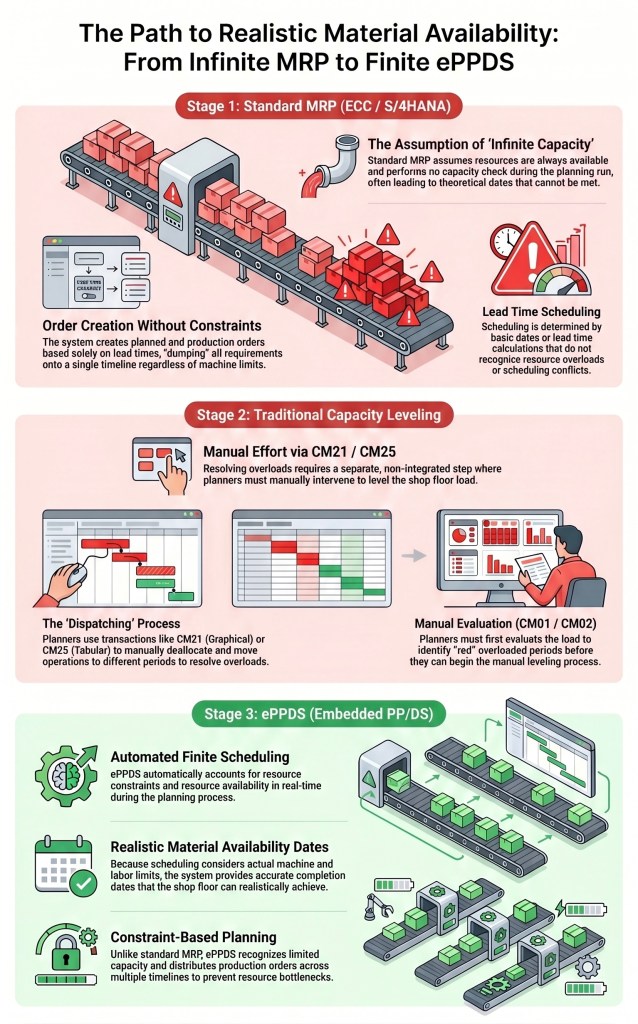
In a business world, we often see companies struggling with production delays despite having a robust ERP. The culprit? Standard MRP’s assumption of infinite capacity.
In traditional ECC environments, MRP generates requirements without checking if your work centers can actually handle the load. This leads to “overload chaos,” where planners are forced into manual, time-consuming leveling.
The Manual Struggle (The ECC Way): Planners must manually evaluate overloads, “dispatch” operations to specific time slots, or increase operating hours just to make the schedule feasible. While this works, it is reactive and often lacks the integration needed for a truly agile shop floor.
The Evolution: Moving to Finite Scheduling with ePPDS🛠️ To arrive at a realistic material availability date, companies are shifting to Embedded Production Planning and Detailed Scheduling (ePPDS)
Why it’s a game-changer:
Finite Scheduling: Unlike MRP, e-PPDS recognizes that machines and people have limits. It performs a capacity availability check during the planning run, not after.
Automation: Instead of manual dispatching, ePPDS automates the distribution of production orders across available timelines, respecting actual resource constraints.
Realistic Commitments: By factoring in actual setup times, processing speeds, and resource availability, your material availability dates become accurate commitments rather than “best guesses.”
The Consultant’s Take: If your production team is spending more time “leveling” in ECC than they are optimizing, it’s time to look at ePPDS. Moving from infinite to finite scheduling isn’t just a technical upgrade—it’s a strategic shift toward shop floor efficiency and customer trust.
How is your organization handling work center overloads? Are you still leveling manually, or have you embraced the automation of PPDS? Let’s discuss in the comments! 👇

 Master Sap Online
Leave a comment