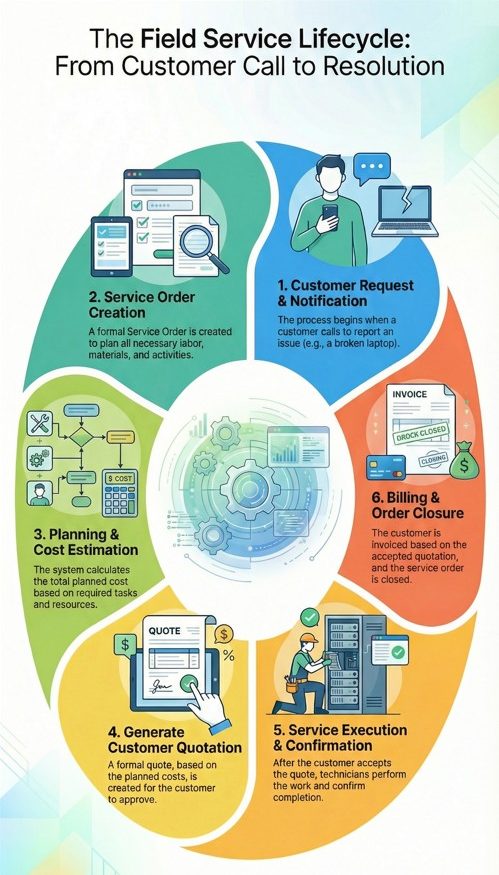
In the world of SAP Customer Service (CS), the field service process is a specialized workflow designed for scenarios where technicians travel to customer locations to perform repairs or maintenance. Unlike in-house repairs, this lifecycle focuses on capturing on-site costs, materials, and labor to ensure accurate service delivery and billing.
Here are the key stages of the field service lifecycle:
1. Service Initiation & Notification 📞 The process typically begins at the Customer Interaction Center (CIC). When a customer reports an issue, a Service Notification is created to document the problem, the affected equipment, and the reported symptoms. This notification acts as the central reporting tool and the starting point for the document flow.
2. Planning with the Service Order 📋 A Service Order is generated from the notification to manage the technical execution. During this phase, planners add:
- Operations: Specific tasks for the technician (e.g., “Motherboard replacement”).
- Components: Spare parts required for the repair.
- Costing: The system calculates Planned Costs based on labor activity types and material prices before the work begins.
3. Field Execution & Confirmation 🔧 Once the technician completes the work on-site, they must report their activities back into SAP:
- Time Confirmation: Labor hours are recorded (e.g., via transaction IW41).
- Goods Movement: Spare parts used are posted against the order (Goods Issue 261), which consumes the stock and records Actual Costs.
4. Financial Completion & Billing 💰 After the technical work is finalized, the lifecycle moves toward financial settlement:
- Technical Completion (TECO): The order is marked as technically complete, preventing further changes to the technical data.
- Resource-Related Billing (DP90): This critical step uses the DP90 transaction to link actual costs (labor and materials) to a Debit Memo Request, ensuring the customer is billed for exactly what was used.
- Settlement: Finally, actual costs are settled to a cost center or profitability segment (CO-PA) to measure the service’s profitability.
By integrating these steps, organizations can maintain a complete document flow—from the initial customer call to the final invoice—providing full visibility into service history and financial performance.
#SAP #CustomerService #FieldService #DigitalTransformation #AssetManagement

 Master Sap Online
Leave a comment